Showing posts with label siemens. Show all posts

Monday, 8 December 2014

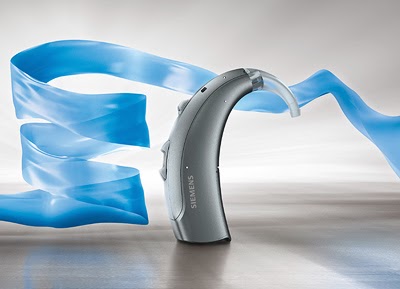
Hear better than ever with Siemens binax hearing aids

Siemens is lifting binaural hearing systems to a new level. For the first time, hearing-impaired individuals can now hear better than those with normal hearing in particularly demanding listening situations*.

Despite their enormous computing power, the new Binax instruments are the most energy-efficient in their class.

Binax exchanges audio signals. Each binaural hearing aid can assess the acoustic environment not only on its own side, but also on the other. In the process, four microphones – two in each device – form a virtual eight-microphone network. New calculation methods work much like the human brain in leveraging the fact that voice signals don't reach both ears at the same speed or volume. Based on such differences, wearers can more accurately identify and focus on the sources of sound.

Binaural hearing aids also use this new technology in windy locations ideal for those golfers and outdoor patients. They automatically determine which side is receiving better signals and replicate them for the other device. These latest Siemens binaural hearing aids are capable of transmitting around a thousand times as much data per second as preceding models.

The new peak performance does not come at the expense of battery life and they can run on conventional hearing instrument batteries or, depending on the model, on rechargeable batteries.

Karen's comments: “We have had amazing success with the last Siemens technology platform called Micon and this new level is so exciting. My team and I can't wait to get started and see how this technology performs and improves peoples lives.”

If you would like to be amongst the first trialling these new instruments, please give our customer care team a call and book your appointment - Freephone 0800 096 2637.

FACT: These latest Siemens binaural hearing aids are capable of transmitting around a thousand times as much data per second as preceding models.


*Two clinical studies have shown that binax provides better than normal hearing in certain demanding environments (Northern Colorado University, 2014; Oldenburg Hörzentrum, 2013): Speech Reception Thresholds in cocktail-party situations improved up to 2.9dB for wearers with mild to moderate hearing loss using Carat binax or Pure binax hearing instruments with narrow directionality, compared to people with normal hearing.

Wednesday, 19 February 2014

New Technology Advancement For Profound Hearing Losses


World renowned hearing aid manufacturer, Siemens, has just released a new hearing aid for people whose hearing is severely impaired. The hearing aid is so thin that it can fit behind the ear of a hearing-impaired baby.

The new device, known as 'Nitro', is one-third narrower than its predecessor, and reason being because that it is equipped with high-performance microchips.

The new device offers an unprecedented sound volume even at the high amplification required for severely hearing-impaired users.

An important feature of hearing aids is that they sufficiently amplify speech to make it easily audible, but at the same time offer a sound experience that is as comfortable and balanced as possible.

The hearing aid receives sound waves through two microphones. The microchips split the sound waves into individual frequency ranges, on the basis of which they create a finely tuned sound no matter what the acoustic situation. The system automatically offsets audio feedback that creates an annoying whistling sound.

Although hearing aids generally have trouble dealing with a babble of voices such as occurs at parties, the new system can also handle such situations by making background discussions quieter so that the wearer can concentrate better on what his or her interlocutor is saying.

The technology within the hearing aid enables it to process a broader range of frequencies and split sounds into as many as 48 individually optimised channels.

Although this results in a huge number of calculations, it does not cause any noticeable sound delays, because the system processes 250 million commands per second. This makes listening with a hearing aid much less strenuous than was previously the case.

The signals from the two directional microphones are individually processed in parallel, enabling the system to more quickly eliminate audio feedback and identify sound sources so that irritating background noises can be filtered out.

Siemens engineers enabled left-ear and right-ear hearing aids to exchange data for the first time in 2004. This allows users to recognise differences in the signals received at each ear so that they can localise a sound source, for example.

I hope I have not bamboozled you with all of my technology speak. Suffice to say, this hearing aid is a fantastic advancement in helping those who have a profound hearing loss. The latest microphone technology in this device reduces listening fatigue substantially and right now no other hearing device for profoundly hearing impaired people can offer a comparable performance.

The key features to take from this new hearing aid are:
  • A third thinner than its predecessor
  • Very high sound volume and high amplification
  • Comfortable and balanced sound experience
  • Twin directional microphones: giving you more balanced hearing
  • Feedback management to filter out unwanted sounds
  • Wireless connectivity: compatible with a range of accessories allowing sound from audio sources directly to your ears